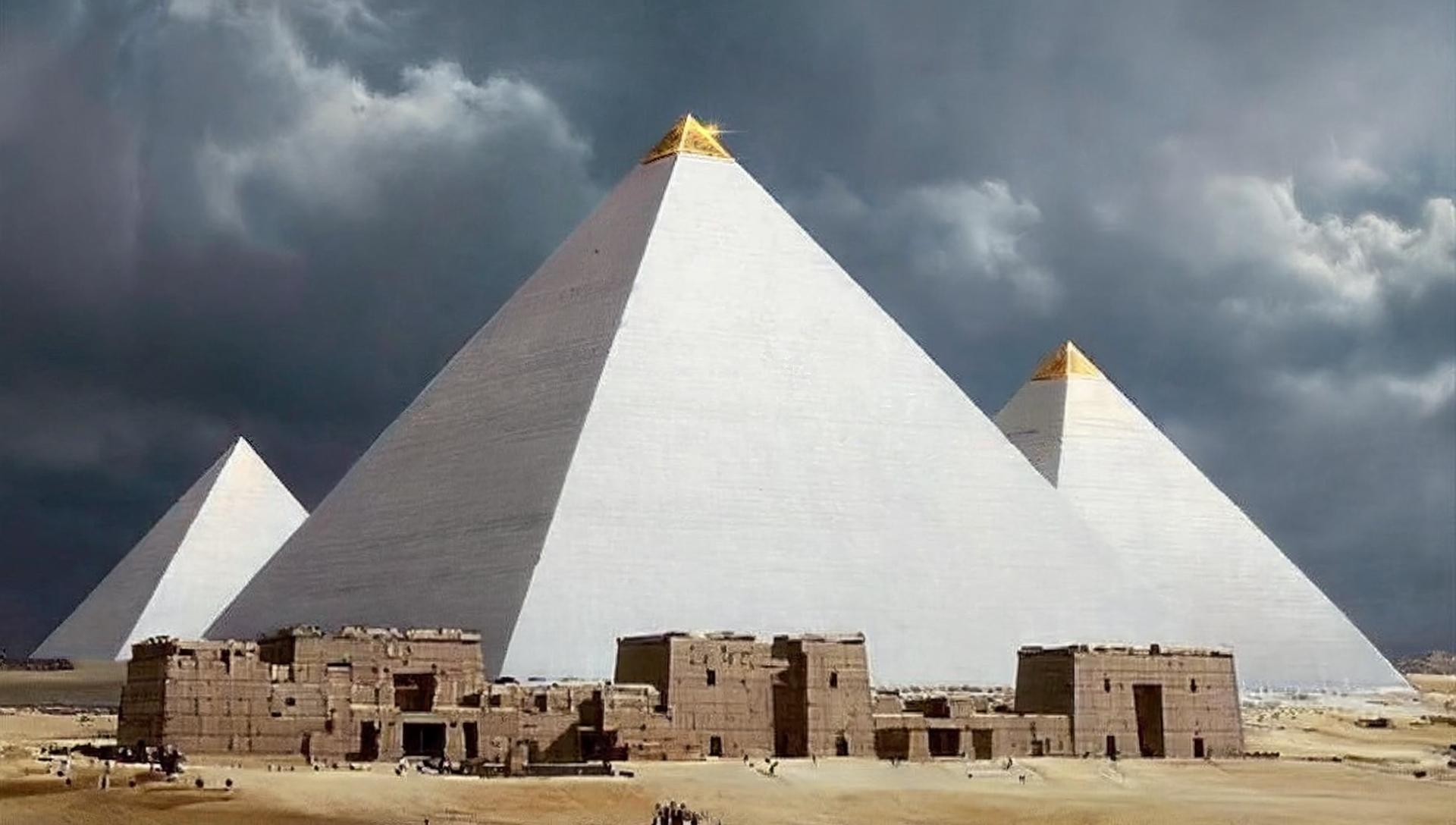
The Great Pyramid of Giza stands as one of humanity's most enduring enigmas, often presented in educational contexts as a monumental tomb for Pharaoh Khufu. However, this interpretation, rooted in 19th-century Egyptology, has faced increasing scrutiny from interdisciplinary perspectives. While not endorsing fringe theories like ancient astronauts or hyperdimensional portals, this post explores architectural, engineering, and scientific anomalies that challenge the tomb hypothesis. Drawing on peer-reviewed research and historical evidence, I argue for a more open, evidence-based reevaluation—one that prioritizes curiosity over dogma. Let's examine the data and question why anomalies are often retrofitted to fit a single narrative rather than prompting revisions. A parallel engineering-centered essay is The Great Pyramid: An Engineering Enigma That Defies the Tomb Theory.
Architectural and Engineering Anomalies: Precision Beyond Funerary Needs
The Great Pyramid's design exhibits feats of precision that surpass what might be expected for a mere burial site. Aligned to true north within 0.06 degrees—a level of accuracy not replicable until modern satellite geodesy—it defies simple explanations (Lehner, 1996). Astronomical correlations further intrigue: the pyramid's layout mirrors Orion's Belt, with statistical analyses indicating improbable chance alignment (Magli, 2015). The shafts align with stars like Alpha Draconis, potentially reflecting ancient sky positions.
Acoustic properties add another layer. The King's Chamber resonates with standing waves and harmonic frequencies, documented by acousticians and suggesting intentional design for sound amplification (Dunn, 1998; ResearchGate, 2024). Electromagnetic studies reveal the pyramid focuses radio waves into its chambers under resonance conditions, as modeled in peer-reviewed physics journals (Evlyukhin et al., 2018). Copper fixtures in sealed shafts resemble wiring, unexplained by funerary traditions but akin to waveguides in modern engineering.
These features—precision alignment, astronomical ties, acoustic resonance, and EM concentration—raise questions: Why embed such sophistication in an empty granite box devoid of hieroglyphs, mummies, or burial artifacts?
Inscriptions and Markings: Functional, Not Funerary
Contrary to claims that the pyramid lacks writing due to its era, evidence exists. The 2011 Djedi robot exploration revealed red ochre markings in a sealed Queen's Chamber shaft—hieratic numerals (100, 20, 1, totaling 121 cubits) interpreted as mason's marks for shaft length (Hawass et al., 2011; NBC News, 2011). Zahi Hawass, leading the mission, confirmed their engineering purpose. This indicates builders used notation for technical precision, yet omitted religious or funerary texts, undermining the "early for inscriptions" argument and supporting a functional, non-symbolic intent.
The Granite Conundrum: Effort, Transportation, and Piezoelectric Potential
The King's Chamber and relieving chambers feature Aswan red granite—quartz-rich, rated 6-7 on the Mohs scale—transported over 500 miles, with blocks up to 70 tons totaling over 1,000 tons (Smith, 2010). Official tools (copper chisels, Mohs 3; dolerite pounders) seem inadequate for millimeter-precision shaping without cracking, a process that would take months per block (Stocks, 2003).
Transportation poses equal challenges. No evidence exists for barges capable of 70-ton loads; the Khufu ship lacks structural reinforcement for such weight (Lipke, 1984). Hypothetical vessels would require advanced buoyancy knowledge, yet no docks, inscriptions, or remains support this (Baines & Malek, 1980). Why import such material when local stone sufficed, if only for a tomb?
Quartz in Aswan granite is piezoelectric, generating charge under stress or vibration—potentially relevant in a resonant chamber insulated by limestone (Deacon, 2024). Theories link this to energy systems, inspired by Nikola Tesla's Wardenclyffe Tower, which aimed for Earth-resonant wireless transmission (Tesla, 1905). While speculative, flawless execution—no cracked blocks or practice attempts—suggests unparalleled engineering.
Recent Discoveries: Underground Anomalies and Coiled Structures?
Recent scans deepen the mystery. In 2024, ground-penetrating radar revealed an L-shaped underground anomaly near the pyramids, potentially man-made (Motoyama et al., 2024). Claims of a 2-km coiled network via Synthetic Aperture Radar (SAR) in 2025 have circulated, evoking inductive energy systems or hydro-powered mechanisms (NY Post, 2025). However, fact-checks label some as overstated or unfounded, emphasizing the need for verification (AFP, 2025; Snopes, 2025). If confirmed, such infrastructure could support non-tomb functions, like energy transmission.
Critiquing the Tomb Theory: The Khufu Cartouche and Dogmatic Responses
The tomb narrative relies heavily on a Khufu cartouche in a relieving chamber, but critiques question its authenticity and sufficiency (Creighton, 2016). No mummy, sarcophagus lid, or funerary glyphs exist—features definitive in other tombs (Lehner & Hawass, 2017). Analogies highlight the fallacy: A name doesn't prove intent, akin to claiming a labeled car as one's tomb.
Egyptologists often retrofit anomalies: Copper as "spiritual handles," shafts as soul paths, resonance as ritual enhancement (Shaw, 2003). This absorbs contradictions without revision, turning theory into dogma. Occam's Razor favors the fewest assumptions; the tomb hypothesis requires many (e.g., lost evidence of looting, undocumented barges) compared to considering alternative purposes based on observed engineering.
Personal encounters, like debating Egyptologists, underscore resistance to interdisciplinary input. Dismissing electrical engineering models (e.g., pyramid as resonator) as "fringe" ignores Tesla's inspirations and published simulations (Balezin et al., 2018). True science demands engaging evidence, not credentialism.
Conclusion: Embracing Curiosity and Interdisciplinary Inquiry
I'm not asserting the pyramid was an energy device—only that the tomb theory fails to explain anomalies without speculation. If discovered elsewhere, we'd demand reevaluation. The 2023 UAP hearings remind us: Dismissing data risks missing truths. Let's apply critical thinking, interdisciplinary lenses, and evidence integrity over authority. What do you think—tomb, enigma, or something more?
References
- AFP Fact Check. (2025). Scientists rubbish claims of 'giant structures' underneath Egyptian pyramids. Retrieved from [https://factcheck.afp.com/doc.afp.com.42LQ7G3](https://factcheck.afp.com/doc.afp.com.42LQ7G3)
- Baines, J., & Malek, J. (1980). *Atlas of Ancient Egypt*. Facts on File.
- Balezin, M., et al. (2018). Electromagnetic properties of the Great Pyramid: First multipole resonances and energy concentration. *Journal of Applied Physics*, 124(3), 034903. [https://doi.org/10.1063/1.5026556](https://doi.org/10.1063/1.5026556)
- Creighton, S. (2016). *The Great Pyramid Hoax: The Conspiracy to Conceal the True History of Ancient Egypt*. Bear & Company.
- Deacon, R. (2024). Piezoelectric Phenomena in the King's Chamber. Dawn of Egypt Blog. [https://dawnofegypt.co/blogs/news/piezoelectric-phenomena-in-the-king-s-chamber-a-new-hypothesis-for-the-shroud-of-turin-s-image-formation](https://dawnofegypt.co/blogs/news/piezoelectric-phenomena-in-the-king-s-chamber-a-new-hypothesis-for-the-shroud-of-turin-s-image-formation)
- Dunn, C. (1998). *The Giza Power Plant: Technologies of Ancient Egypt*. Bear & Company.
- Evlyukhin, A. B., et al. (2018). Electromagnetic properties of the Great Pyramid: First multipole resonances and energy concentration. *Journal of Applied Physics*, 124, 034903. [https://doi.org/10.1063/1.5026556](https://doi.org/10.1063/1.5026556)
- Hawass, Z., et al. (2011). Djedi Project Report. Annales du Service des Antiquités de l'Égypte.
- Lehner, M. (1996). *The Complete Pyramids*. Thames & Hudson.
- Lehner, M., & Hawass, Z. (2017). *Giza and the Pyramids: The Definitive History*. University of Chicago Press.
- Lipke, P. (1984). The Royal Ship of Cheops. *British Archaeological Reports*.
- Magli, G. (2015). Archaeoastronomical Study of the Main Pyramids of Giza, Egypt: Possible Correlations with the Stars. *Archaeoastronomy and Ancient Technologies*, 3(1), 1-10. [https://www.scirp.org/journal/paperinformation?paperid=61389](https://www.scirp.org/journal/paperinformation?paperid=61389)
- Motoyama, M., et al. (2024). Ground-penetrating radar and electrical resistivity tomography reveal a mysterious L-shaped anomaly under the Western Cemetery in Giza, Egypt. *Archaeological Prospection*. [https://doi.org/10.1002/arp.1941](https://doi.org/10.1002/arp.1941)
- NBC News. (2011). Mystery of pyramid hieroglyphs: It all adds up. [https://www.nbcnews.com/id/wbna43314221](https://www.nbcnews.com/id/wbna43314221)
- New York Post. (2025). Vast underground city found below Egypt's Giza pyramids: scientists. [https://nypost.com/2025/03/23/world-news/vast-underground-city-found-below-egypts-giza-pyramids-scientists/](https://nypost.com/2025/03/23/world-news/vast-underground-city-found-below-egypts-giza-pyramids-scientists/)
- ResearchGate. (2024). Investigating the Cavity Resonance Acoustic Properties of the Great Pyramid. [https://www.researchgate.net/publication/381806657_Investigating_the_Cavity_Resonance_Acoustic_Properties_of_the_Great_Pyramid_for_Free_Energy_Generation_A_Study_of_the_King%27s_Chamber_and_Its_Potential_Applications](https://www.researchgate.net/publication/381806657_Investigating_the_Cavity_Resonance_Acoustic_Properties_of_the_Great_Pyramid_for_Free_Energy_Generation_A_Study_of_the_King%27s_Chamber_and_Its_Potential_Applications)
- Shaw, I. (2003). *The Oxford History of Ancient Egypt*. Oxford University Press.
- Smith, C. B. (2010). *How the Great Pyramid Was Built*. Smithsonian Books.
- Snopes. (2025). No credible evidence supports claims of vast underground structures under Giza pyramids. [https://www.snopes.com/fact-check/pyramids-of-giza-new-discovery-structures/](https://www.snopes.com/fact-check/pyramids-of-giza-new-discovery-structures/)
- Stocks, D. A. (2003). *Experiments in Egyptian Archaeology: Stoneworking Technology in Ancient Egypt*. Routledge.
- Tesla, N. (1905). The Transmission of Electrical Energy Without Wires. *Electrical World and Engineer*.
*Disclaimer: This post is for informational purposes only and presents a critical perspective based on cited sources. Interpretations are my own and do not endorse unverified theories. *